
Literature Digest | Multiplex Digital PCR for Rapid Quantitative Detection and Dynamic Monitoring of Respiratory Pathogens in Bronchoalveolar Lavage Fluid

Beijing Tsinghua Changgung Hospital in collaboration with Tsinghua University | Published in Analyst (Royal Society of Chemistry), 2026, 151, 5890 — selected as a cover article
Recently, research from Beijing Tsinghua Changgung Hospital in collaboration with Tsinghua University was published in Analyst, an academic journal of the Royal Society of Chemistry. The paper, entitled “Multiplex digital PCR for rapid quantitative detection and dynamic monitoring of respiratory pathogens in bronchoalveolar lavage fluid,” was selected as a cover article of the journal and simultaneously promoted on LinkedIn, drawing attention from the international academic community.
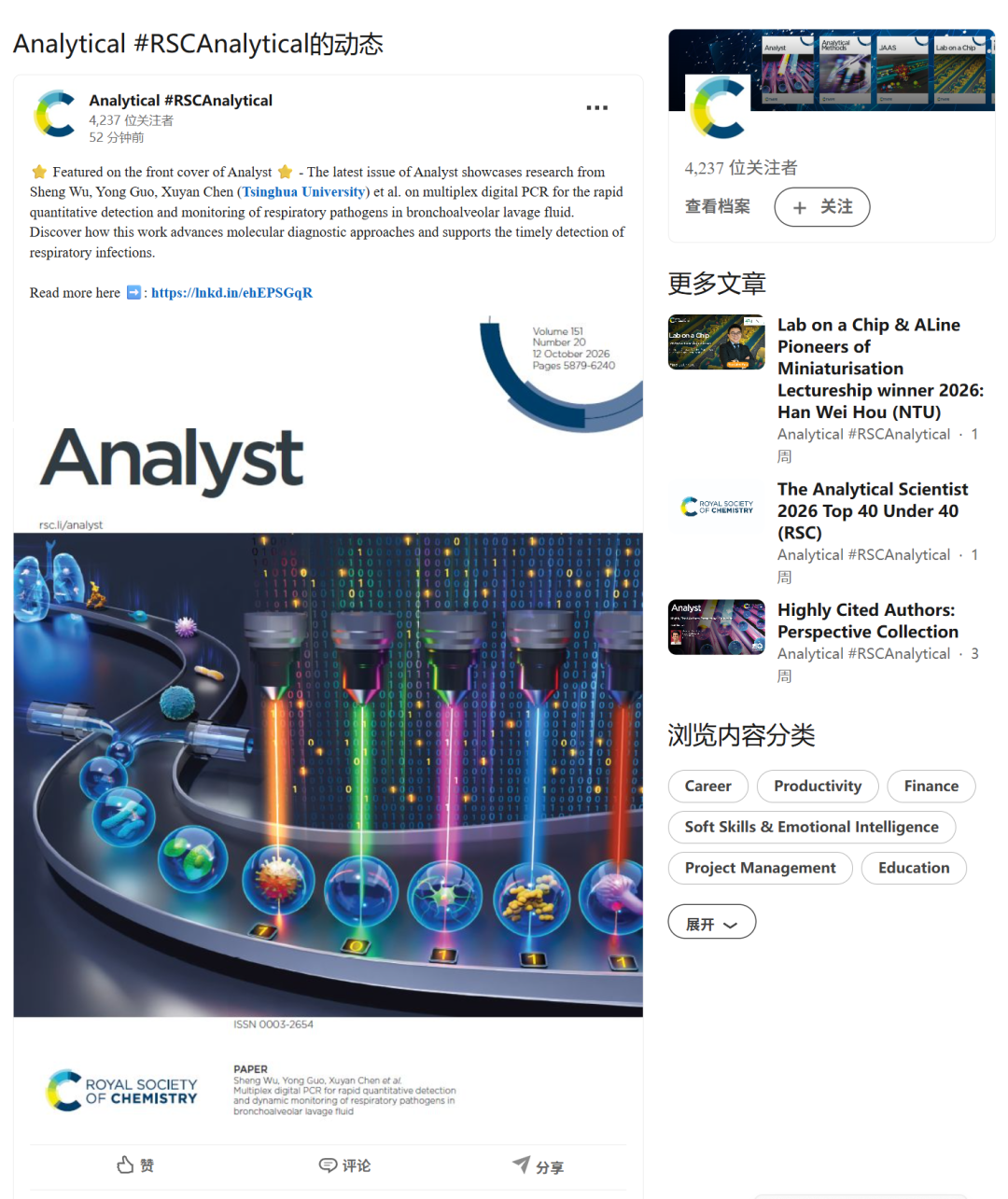 The study developed a digital PCR (dPCR) assay covering 33 pathogens, enabling absolute quantification of bacteria, viruses, fungi, and atypical pathogens in bronchoalveolar lavage fluid (BALF). The study also systematically compared different BALF pretreatment methods and validated the assay’s performance on 105 clinical samples. The complete workflow from sample pretreatment to result output can be completed in approximately 2.5 hours, offering a new technical approach for rapid etiological detection of lower respiratory tract infections and dynamic monitoring of pathogen load
●
Why rapid, quantitative detection of lower respiratory tract infections matters
●
Lower respiratory tract infection is one of the major infectious disease burdens worldwide. For critically ill and immunocompromised patients, the ability to rapidly and comprehensively identify pathogens directly affects the formulation and adjustment of anti-infective treatment strategies. However, existing detection methods each have limitations:
Conventional culture typically takes 3–7 days and offers limited sensitivity for fastidious bacteria and samples from patients already receiving antimicrobial therapy. Metagenomic next-generation sequencing (mNGS) has the advantage of broad, unbiased detection, but its routine clinical application is still constrained by cost, data-analysis complexity, and turnaround time. Some syndromic multiplex PCR panels enable rapid screening but mainly provide qualitative or semi-quantitative results.
Clinicians therefore need to know not only “whether a pathogen is present,” but also “how much of it there is,” “whether multiple pathogens are present at the same time,” and “how the pathogen load changes over the course of treatment.
●
The value of dPCR: not just detection, but absolute quantification
●
Digital PCR achieves absolute quantification of nucleic acids without relying on standard curves, and offers high sensitivity and strong tolerance to PCR inhibitors. Applied to BALF testing, it promises rapid screening of multiple pathogens while providing copy-number information for each pathogen, laying a data foundation for identifying mixed infections and continuously assessing pathogen load. However, mucus and inhibitory substances in BALF samples may affect nucleic acid recovery and subsequent amplification. For a multiplex assay covering both RNA viruses and DNA pathogens, the pretreatment method must also preserve the integrity of different types of nucleic acids. To address this, the study not only established a 33-pathogen assay but also systematically compared 5 BALF liquefaction protocols and sel
●
The dPCR workflow
●
The assay covers 13 bacteria, 12 viruses, 5 fungi, and 3 atypical pathogens, with a human internal reference gene included. The 33 targets are distributed across 7 reaction tubes, each detecting 5 targets.
The overall workflow consists of three steps:
- Sample pretreatment and nucleic acid extraction. BALF samples are liquefied with dithiothreitol (DTT), followed by automated nucleic acid extraction.
- Reaction setup. The multiplex dPCR reaction system is prepared, and reverse transcription and chip loading are completed.
- Automated detection and data analysis. Based on the TargetingOne D50 digital PCR system, droplet generation, PCR amplification, and droplet signal reading are completed automatically, and the analysis software calculates the copy number of each target.
From sample receipt to final result output, the entire workflow takes approximately 2.5 hours.
ected a universal pretreatment workflow suitable for simultaneous RNA and DNA detection.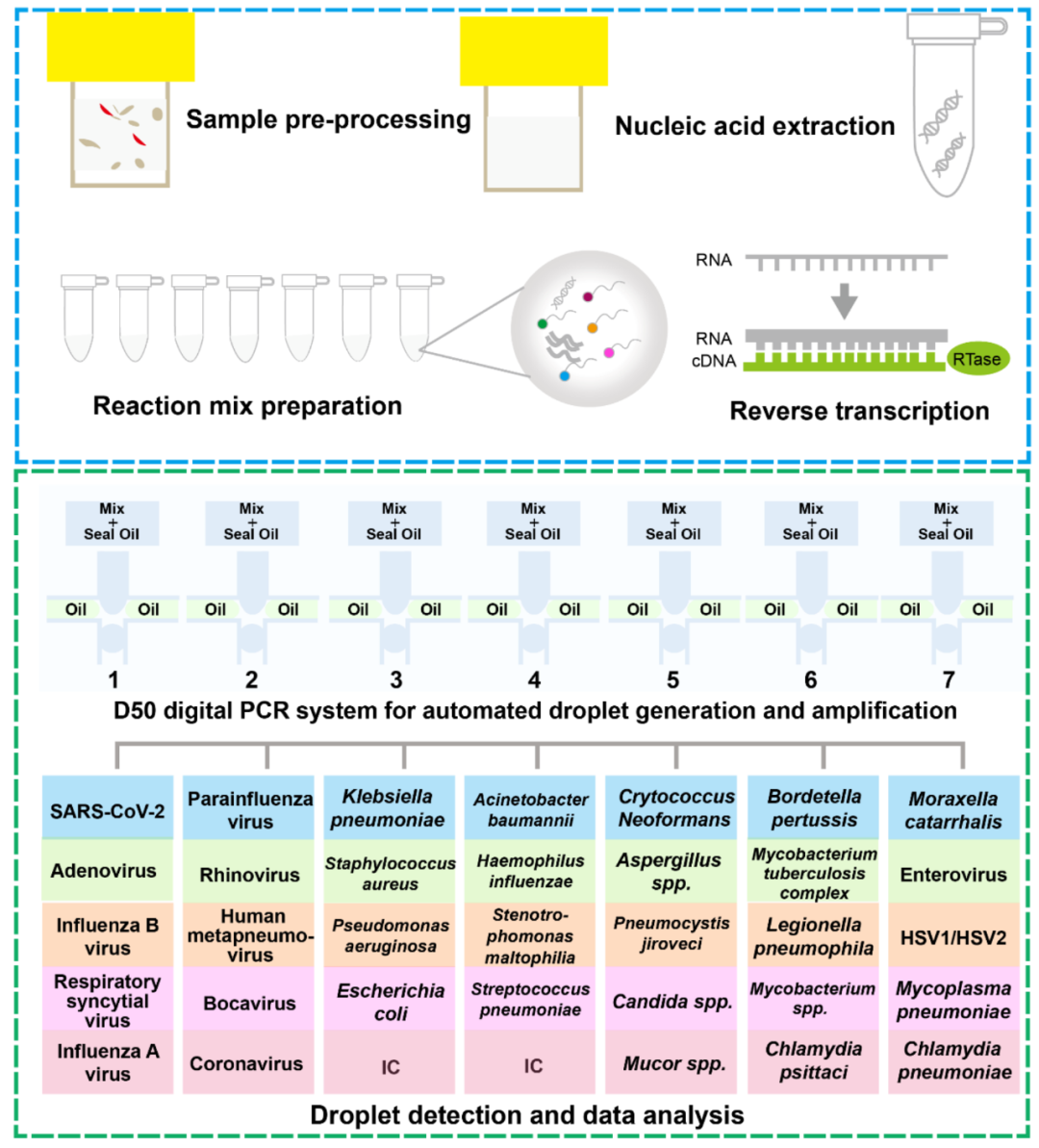
●
Result 1: Good repeatability, stable quantification even for high-copy samples
●
The study compared 5 pretreatment protocols: normal saline, DTT, 4% NaOH (with and without centrifugation), and a sputum digestive solution. The results showed that although 4% NaOH liquefied samples rapidly, its alkaline conditions could compromise RNA integrity, making it unsuitable for comprehensive assays covering both RNA and DNA targets. DTT, by contrast, effectively liquefied sputum while delivering consistent and balanced nucleic acid recovery for RNA viruses, DNA viruses, bacteria, and fungi.
In terms of analytical performance, the limit of detection for all 33 targets was as low as 5 copies/test. Within the evaluation range of 10–10⁵ copies/test, the linear correlation coefficient R² of each target exceeded 0.99; 27 targets showed good linearity across the full range, while the remaining 6 showed good linearity within 10–10⁴ copies/test, with 10⁵ copies/test as their upper detection limit. These results indicate that the assay combines a low limit of detection with a wide quantitative range.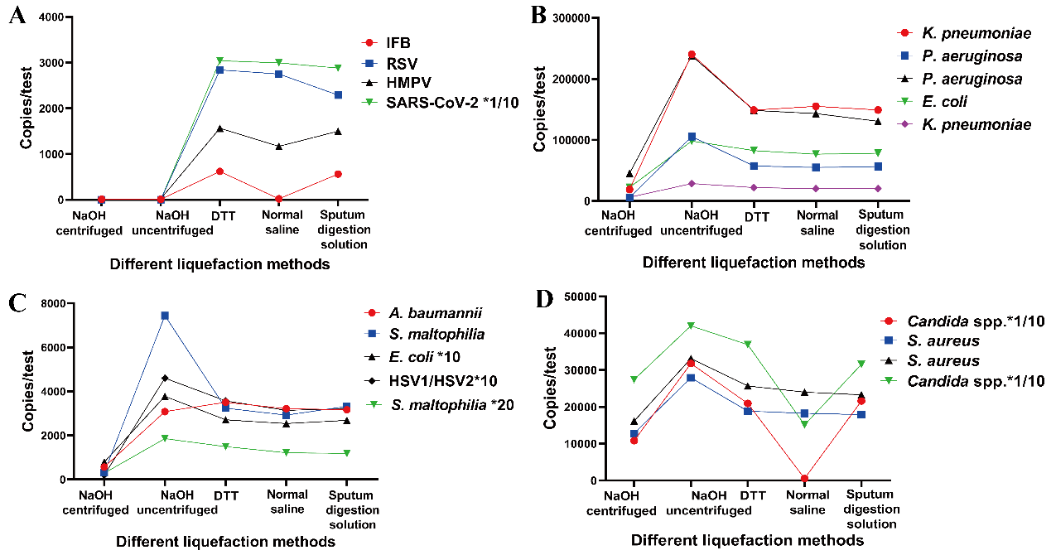
●
Result 2: Higher positive detection rate than culture, with outstanding advantages in multi-pathogen detection
●
The study enrolled 105 BALF samples from patients with suspected pulmonary infection and compared dPCR results with conventional culture. The overall positive rate of dPCR was 96.19% (101/105), significantly higher than 83.81% (88/105) for culture (P < 0.05). The advantage of dPCR was even more pronounced in identifying mixed infections: for samples with two or more pathogens detected, the multi-pathogen detection rate of dPCR was 85.71% (90/105), compared with 40.00% (42/105) for culture. In addition, dPCR could detect viruses, non-culturable pathogens, and certain fastidious pathogens that culture struggles to cover, and maintained high sensitivity for low-abundance nucleic acid targets, thereby providing a more comprehensive pathogen spectrum.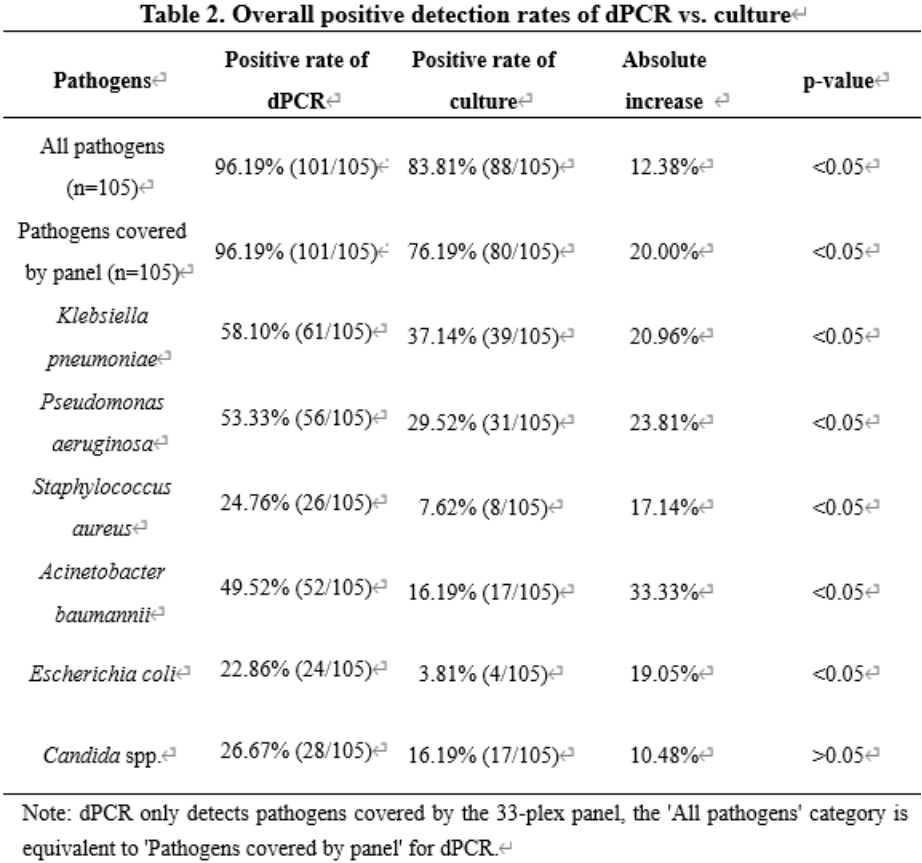
●
Result 3: High consistency with mNGS for major pathogen detection
●
Among the 29 samples verified by mNGS, the positive rates of dPCR, mNGS, and culture were 89.66%, 82.76%, and 55.17%, respectively. For the 23 samples positive by both dPCR and mNGS, the concordance rate between the two methods in identifying major pathogens was 86.96% (20/23), further supporting the reliability of the dPCR results. For rare or emerging pathogens not covered by dPCR, mNGS retains its value for broad-spectrum screening. dPCR and mNGS can complement each other according to clinical needs, offering more options for etiological testing in different scenarios
Result 4: Absolute quantification shows potential for dynamic monitoring
●
The study also conducted an exploratory analysis of one patient with severe lower respiratory tract infection, retrospectively testing BALF samples collected over approximately 4 months and performing absolute quantification of Pseudomonas aeruginosa and Klebsiella pneumoniae. The results showed that the load changes of the two pathogens paralleled the patient’s clinical course and response to anti-infective therapy. During treatment, the two pathogens exhibited differentiated load dynamics; after the treatment regimen was adjusted, the loads of both pathogens declined to low levels. This single-case result preliminarily suggests that serial dPCR quantification can be used to observe pathogen load dynamics and provide multi-dimensional information for evaluating treatment response.
Summary: from “pathogen detection” to “pathogen quantification and dynamic assessment”
●
The study established a 33-respiratory-pathogen assay based on the TargetingOne digital PCR platform, integrating DTT pretreatment, automated nucleic acid extraction, multiplex dPCR detection, and absolute quantification analysis, and completing multi-pathogen testing of BALF samples in approximately 2.5 hours. The assay focuses not only on “whether a pathogen is present” but also answers “how much of each pathogen there is,” and demonstrates the technical potential for continuous quantification of “how pathogen load changes over time,” providing a new tool for rapid etiological diagnosis of lower respiratory tract infections, identification of mixed infections, and dynamic monitoring research.